Friday, March 9, 2012

1967 Hagstrom III


The Hagstrom H model guitar (they were available in I,II, and III designations) resemble what would happen if a Gibson SG and a Fender Jaguar were to have made love and procreated on a romantic holiday in Sweden. While quirky, these instruments sound great and are of typically excellent quality.

This three pickup model III was the most deluxe of the H series guitars, and this one is finished in a European equivalent of Dakota red to cap off this ultra cool guitar. Tonally, the guitar is very similar to a Fender Stratocaster, and does the "in-between" nasally tones quite well when the neck/middle or middle/bridge pickups are turned on together. There's also some other switches that muffle and thin out the tone that are basically useless, in my opinion. In addition to all those excellent features, this guitar has a thick Brazilian rosewood fingerboard capped onto a very slim, low profile neck, with a low tension 24 1/2' scale.

A fantastic buy on the vintage guitar market, especially for those players who are smaller/ shorter in stature.


all images courtesy of the author; c2012 Derek See

Tuesday, March 6, 2012

1967 Epiphone Bard


As part of the emerging folk-rock boom, every major manufacturer of guitars in the sixties took a ride on the 12 string train, doing their best to appease those that wanted to jangle away the days.

This Gibson-made Epiphone is a rarely seen model from the era that was made in very limited quantities. On top of that, the immense pressure that 12 strings puts on an acoustic guitar has insured that even fewer have lasted through the years.


Images courtesy of Gryphon Stringed Instruments.

Coral Electric Sitar


I think this model is best summed up by what my friend Larry (who graciously loaned me this instrument for this site) said when he told me he was gonna pry it away from me: "I hope you had a chance to get your swami on!"

I certainly did. This thing is a real gas (but don't try to play chords on it, as they do not properly intonate).

Built by Coral (an offshoot of the Danelectro/ Silvertone empire), the Coral sitar features a "buzz" bridge designed by session musician Vinnie Bell in response to the call for sitars on recordings after the introduction of the exotic tones to the western world on "Norwegian Wood". With movable frets and drone strings, true sitars are incredibly difficult to master, which put Bell's wheels in motion to create an instrument that could be played easily by a guitarist but still brings out the inner swami in all of us. The drone strings don't drone in sympathy a whole lot, but they make for a fun racket when struck.

The Coral sitar was heard on many fine records, including The Box Tops "Cry Like A Baby", many early '70's tracks by the Stylistics, "It's A Shame" by The Spinners, "I Was Made To Love Her" by Stevie Wonder, "Hooked On A Feeling" by BJ Thomas, and "Monterey" by The Animals.


Guitar loaned by Larry Chung; images c2012 Derek See

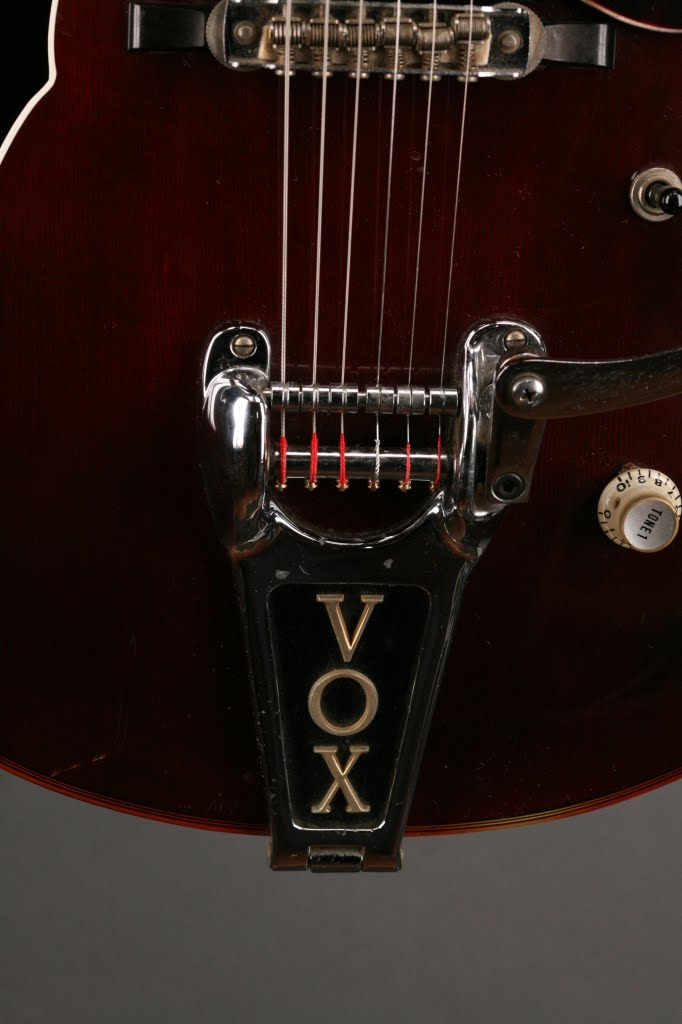
1968 Vox Aristocrat


Cutting an iconic mod image with his white, teardrop shaped English-made Vox guitar, Brian Jones sparked a six string revolution. With the emerging radical styles seen in the hands and on the backs of the British bands, the coolness factor of a Vox branded guitar was and is a perfect match with Chelsea boots, white 501's, shaggy haircut and a striped pullover. Problem was that UK based JMI (Vox' parent company) simply could not keep up with the demand of amplifier and guitar production. In 1965, amps bearing the Vox name were built in southern California, and EKO in Italy was contracted to build more Vox branded guitars (including the legendary MARK series teardrops and the trapezoid like Phantom).

In 1967, Vox (in what can be seen as a last gasp effort) introduced four guitars in this shape which was clearly inspired by Gibson's ES-335. However, these guitars are fully hollow, making them more like an ES-330. The other three models (Cheetah, Ultrasonic and Viper saw the installation of the same built in effects as the Starstream model that I featured a few weeks ago. The Aristocrat, however, had no built in effects and therefore is a much "cleaner" design.

This Aristocrat is fairly unusual, as it features more deluxe fretboard inlays (most had solid blocks without the diagonal hash as seen here) and a plain headstock with only a large VOX logo; this one has the more intricate floral inlay and a smaller VOX logo.

With their microphonic pickups, bolt on maple neck and fully hollow construction, these guitars have a VERY psychedelic, haunting sound. Trivia: Pete Townsend smashed a Cheetah in the famous performance of THE WHO on the Smothers Brothers show in '67.


Images courtesy of the author; c2012 Derek See.

Sunday, February 26, 2012

Harmony Hollywood


Just in time for the Oscars, I'm proud to present this kitschy cool piece of Americana.

Ever see another sunburst-type finish like this? Added to Oscar on this headstock, this is a little slice of art deco that would have been nostalgic in the 60's.

My friendwho owns this guitar moved from New York to California in the mid-70's, with big dreams and little money. Unfortunately, he had to sell off his other guitars to stay alive, but with 40 bucks in his pocket he bought this guitar in Berkeley, CA. He did very well for himself and counts some lovely instruments among his collection, yet still treasures this funky old box.

Full of visual appeal, it's also charming plugged it, and added to the backstory it's easy to see why he's hung on to this beauty.


Guitar courtesy of Shaky Ceasefire. Images c2012 by Derek See.

Friday, February 24, 2012

1967 Standel


Known more for unique California-made amplifiers, Standel guitars are a rare sight. Standel's final attempt at guitars resulted in a partnership with the Harptone case company (Newark, NJ) in 1967 of which this lovely guitar is an example of. While there is no model designation on the guitar, it is very similar to a Guild Starfire model guitar although that amazing headstock design is in a class of its own. These guitars were quite expensive at the time and very few were made.

The electronics of this guitar were quite anachronistic for the time, as they were the type of DeArmond brand pickups that Gretsch had used in the 50's.


Guitar courtesy of an anonymous collector; images c2012 Derek See.

1965 Martin D-28


While the D-28 was introduced by Martin in the early 1930's, it proved to be an incredibly popular and important guitar in the 1960's, as both John Lennon and Paul McCartney each bought brand new D-28's in 1967, which are heard all over "The Beatles" (aka The White Album), "Abbey Road" and "Let It Be".

This particular guitar was built with a set of awe-inspiring Brazilian rosewood; probably the most coveted wood of all, in terms of acoustic guitars. Martin stopped using Brazilian rosewood in 1969, as regulations regarding its harvest began to fall into effect (thankfully). The downside of the use of this beautiful wood was the decimation of the Brazilian rain forest.

Perhaps the ultimate singers' guitar, the D-28 became synonymous with acoustic rock.

About ten years ago, I scraped together money I basically didn't have by selling off a bunch of other things (a couple of guitars, some records, etc) in a manic week of ebay auctions because I HAD TO HAVE THIS GUITAR. four years ago, I HAD TO HAVE ANOTHER GUITAR and had to sell this one. FORTUNATELY in one of the most incredible twists of fate I've ever been able to experience first hand, I was reunited with this guitar a year ago when it became available again. This time around, I will NEVER sell it. It's meant to be I reckon.